
After the launch of ChatGPT, a groundbreaking AI chatbot that can generate high-quality articles quickly, many people, especially content writers, felt anxious.
Within just five days of its launch in November 2022, ChatGPT gained 1 million users and now has an impressive user base of 100 million people who rely on it for various tasks.
Although this technology is still new and not fully understood by most people, its remarkable capabilities are highly appealing. However, there are concerns that ChatGPT could threaten traditional jobs and raise questions about the future of AI replacing human workers.
This article explores this topic thoroughly, explaining what ChatGPT is, to what extent it can potentially replace the role of an average content writer, and whether this poses a significant problem for the future.
The Role of an Average Web Content Writer

Writing content involves challenges and tasks familiar to most people in this field. Content writers, especially those working on the web, often have overlapping responsibilities with digital marketers, as their articles often serve to market and sell products and services.
To create successful articles, content writers need a clear understanding of their target audience, expert knowledge of the subject matter, the ability to adapt to different tones of voice, and strong writing skills to produce coherent and logical reports. Some of these skills can be acquired through experience, while others may need to be communicated during the onboarding process, which is managed by the team in charge.
Thorough research is a crucial aspect of content writing and often the most challenging part. Content writers spend significant amounts of time researching the given topic. Additionally, writing an article can take anywhere from 4 hours to even longer, depending on the subject and word count. Content writers must also be proficient in outlining the essential elements of the topic and structuring the article in a logical order that makes sense to the reader.
Sometimes, content writing positions may require SEO knowledge (Search Engine Optimization), as it overlaps with content writing when a company prioritizes SEO and relies heavily on search engine traffic.
Additionally, content writers need to edit their work to ensure it is polished and valuable. When starting a new job, they also face the challenge of integrating well with the team by possessing soft skills.
The HR team or recruiter plays a role in determining whether a candidate is a good fit during the interview process.
What is ChatGPT and How Does it Work
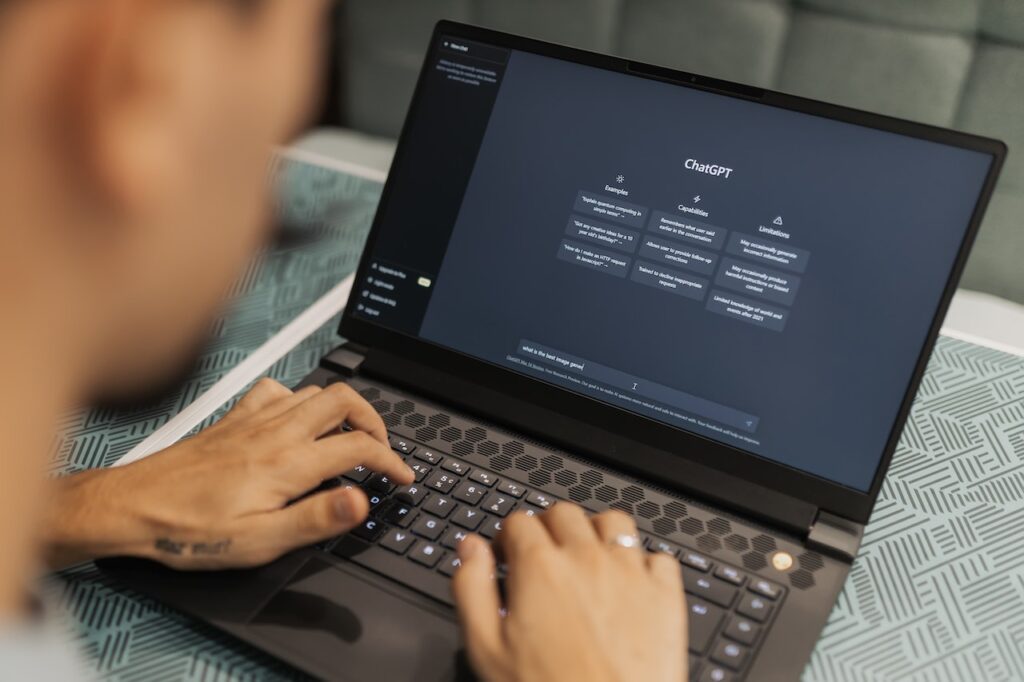
ChatGPT is a helpful assistant designed to assist users in generating responses based on the patterns and structures of human language.
This AI-powered assistant was created by OpenAI, a research lab that trained it on vast text data from various sources such as books, articles, websites, and more.
It analyzes the user’s input and generates a response based on the information it learned during training. To use ChatGPT effectively, users need to know how to write a prompt or command to help ChatGPT understand what users need to generate.
Prompts need to be contextual, correct, and logical. Users need to provide ChatGPT with enough information to receive satisfactory results.
However, it’s important to note that ChatGPT doesn’t have access to real-time information beyond what it was trained on, which includes data up until September 2021.
While it strives to offer accurate and helpful information, it’s always advisable to verify critical information from reliable sources as there is a possibility of generating incorrect or nonsensical responses.
How can ChatGPT integrate into content writing tasks
ChatGPT is a powerful and versatile tool easily integrated into content writing tasks.
ChatGPT has been used for writing essays, creating outlines, editing, simplifying complex articles, generating content ideas, detecting content gaps, incorporating an appropriate tone, and providing prompt feedback and suggestions for enhancing content.
One of its most significant advantages is its speed, providing quick responses and suggestions.
This can boost writing efficiency, enabling you to meet deadlines and handle multiple projects simultaneously. Incorporating this chatbot correctly can significantly fasten and improve content production, saving you much time.
By using appropriate prompts, ChatGPT can handle almost any inquiry effectively.
Ways to use ChatGPT for content production
- Outline Creation: It can help you create a well-structured outline that addresses all the reader’s questions and follows a logical order.
- Content Idea Generation: ChatGPT can generate content ideas to showcase your expertise. It helps you inform and answer potential questions that your readers might have, ensuring that your content is informative and valuable.
- Editing Support: You can rely on ChatGPT to edit your content and make it error-free, polished, and coherent. It assists in identifying and rectifying grammar errors, ensuring that your writing is professional and high-quality.
- The tone of Voice Integration: By leveraging ChatGPT, you can incorporate a specific style of voice in your writing to appeal to your target audience.
- Editor and Feedback Provider: ChatGPT can function as an editor, offering constructive feedback to enhance your writing.
- Summarization of Long Articles: If you come across lengthy articles, ChatGPT can assist you in summarizing the main points.
- Writing style imitation: ChatGPT can imitate your writing style and make the article as if you reported it.
- Elevating your writing: ChatGPT can improve written articles by using more profound words that truthfully capture a specific message’s meaning. It can also help with awkward sentencing by improving the structure and offering relevant terms.
Limitations of ChatGPT
- ChatGPT has limited knowledge until September 2021, which means it doesn’t have access to information or events that have occurred after that time.
- Generates responses that may be biased, inaccurate, or incomplete.
- It does not possess the capability to develop entirely new ideas that have yet to be introduced in its training.
Why does ChatGPT impose a threat to content writers in the workplace?

One of the biggest challenges almost all employees face is the speed and accuracy they must provide in the workplace, which many call efficiency.
The more efficient you are, aka the more things you can finish in the shortest amount of time with high quality and little resources, the higher your chances are to keep your job and grow within the company.
Companies of any size constantly race for time and operate on a limited budget.
Therefore, a high-performing employee that can easily integrate into the team, learn the ropes of the job, can do many tasks outside the scope of their job description, and start giving results on the spot is the employee that most companies want.
However, the reality is much different. The average employee requires an onboarding process of several weeks to several months, needs to integrate into the organization, needs accommodations, needs to be paid, needs to be invested in his career development, and, most of all, needs to be found through an often extensive recruitment process.
ChatGPT, on the other hand, is a pre-trained model that is right under your fingertips and can be free of charge or paid just $20 a month. The efficiency of the AI chatbot is incredible, as it can generate almost anything you need in a few seconds and can be used for any question ranging from development to physics to marketing and whatnot.
The weak spot of ChatGPT, however, is the inability to produce new and unique pieces that can only be learned through experience. In addition, for users to utilize ChatGPT efficiently, they need to know how to write a prompt that covers key elements that will trigger the bot to give precise and detailed answers. It’s necessary for the person giving orders to know what he’s looking for, that is, to be an expert on the subject. Otherwise, the chat will provide unsatisfactory answers that are superficial and useless.
So, what does this ultimately mean for content writers specifically?
As of now, content writers are much needed in the workplace. First, because of their ability to do thorough research on a subject necessary for producing an accurate, unbiased, valuable, and objective piece of content. Furthermore, niche content writers can offer expertise gathered from years of experience and share helpful information and insight on a specific topic.
Professional content writers may not be necessary for businesses with fewer than five employees or small businesses that must produce short, fast content, such as social media descriptions. ChatGPT can do that promptly, saving them time and money. In the near future, content writers might be replaced in smaller businesses where having a content writer is not at the top of the priority list or where content writing tasks can be done single-handedly in a few hours a week.
Companies that show their expertise primarily through written content mustn’t rely solely on ChatGPT. They will still need experts or niche content writers with sharp writing skills.
Companies considering integrating ChatGPT as their full-time employee will still need an editor to fact-check what ChatGPT has generated, a prompt engineer that can craft the proper prompts, and a content manager to monitor and coordinate the entire content workflow. This also might open a new opportunity for the “word experts” to move from their traditional jobs and become prompt engineers.
Every continent writer can use ChatGPT’s abilities to polish their writing, find content gaps, and seek feedback to elevate their writing.
Protests and Call for Regulation
The groundbreaking technology raised many worries even upon its initial arrival. Strikes began happening in a few places around the world.
According to Polygon, at the beginning of May 2023, The Writers Guild of America, representing TV and movie writers, began a strike following unsuccessful negotiations with the Alliance of Motion Picture and Television Producers, affecting production and late-night talk shows, as writers demand better pay, stable working conditions, improved health coverage, and regulation on the use of artificial intelligence, while the companies resist changes.
The Writers Guild of America wants to ban AI from replacing writers, but the industry has rejected this. Artists, journalists, and others are also joining the movement. The main concerns are the power of big tech companies and the potential harm to creative careers.
Los Angeles Times has reported that Twitter users started tweeting experiences where copywriters began losing their jobs to ChatGPT.
According to a report from Goldman Sachs, artificial intelligence (AI) has the potential to substitute around 300 million full-time jobs, reported BBC.
Regarding the regulation, Sam Altman called for global regulation of generative AI during his visit to South Korea, highlighting concerns about the potential impact and speed of technological revolutions while governments are feeling pressure to regulate AI. Experts warn of the risk of human extinction, with estimates suggesting that generative AI automation could affect up to 300 million jobs worldwide.
Geoffrey Hinton, or the “Godfather of AI,” whose majority of his life was devoted to learning and understanding AI, has also quit Google to be able to talk about the dangers of artificial intelligence without having to worry about the impact that those opinions would have on the company where he worked.
The resistance to AI’s expansion is increasing, but a challenging and continuous struggle remains to determine the future of work and the beneficiaries of AI progress.
The Future of AI
In recent months, the market has seen a surge of over 100 AI-powered tools that aim to simplify everyday tasks and enhance employee productivity.
Many companies have adopted AI solutions to automate their daily responsibilities. Google is also developing its own AI chatbot, which can potentially change SEO and website traffic.
According to India Times, Microsoft has reportedly invested 13 billion dollars in Open AI. Quora, the popular Q&A site, has partnered with ChatGPT to launch its bot.
Social media is buzzing with tips and advice on utilizing ChatGPT and other powerful AI tools.
We have entered the AI era, and this technology will continue to become more integrated into our daily lives.